

sheet-pan miso-ginger salmon
don't freak out, salmon-haters! you can swap in chicken!
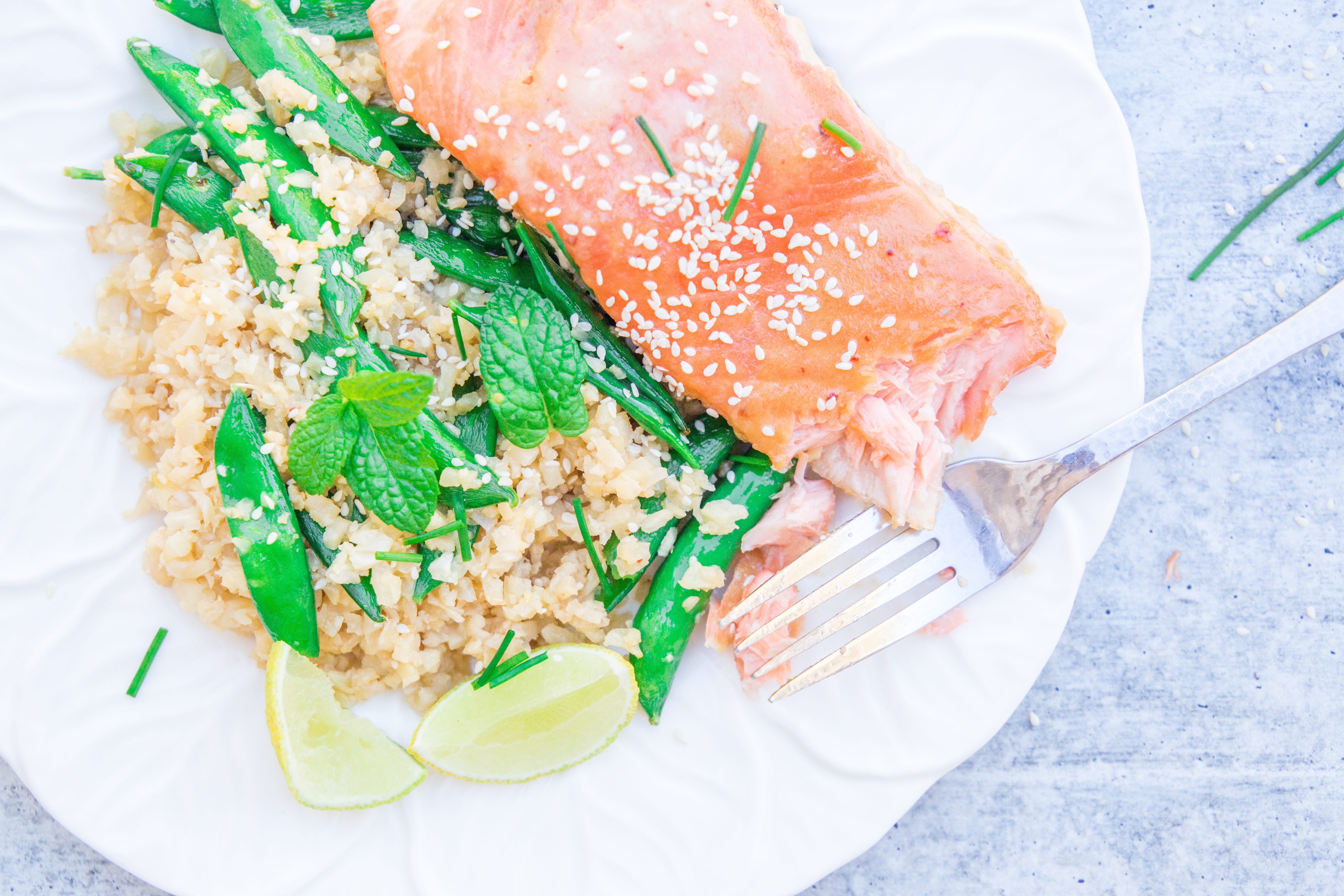
Happy monday, and happy 2021!
At some point maybe it will stop BLOWING MY MIND how much this What to Cook crew has grown in just 3 weeks since launch, but that day is not today! So, welcome to the new folks, I’m so glad you’re here, and I’m so excited to plan 52 of your meals (not including repeats!) for you over the next year (and beyond!).
Whether you’re a novice home cook or a budding chef, everyone has days when they just don’t feel like cooking. So, I challenge you to cook at least the one recipe I send you each Saturday, every single week, for the next year. Shake up your typical dinner time routine, learn some new skills, and dabble in new cuisines.
I’m not a fan of the whole “new year, new you” crash diet, but I am a fan of a nice January reset. To kick off january, i’m giving you guys an absolutely delightful meal that consists of lean protein, a large portion of cauliflower rice, and snap peas — all cooked on just one sheet-pan.
The miso-ginger marinade is so beyond delicious that you’ll be hunting for more ways to consume it immediately (slather it all over chicken or pork tenderloin and roast it! Toss sautéed asparagus or green beans in a couple tablespoons of it!).
If you are intimidated by cooking fish, this is the recipe for you. It is nearly impossible to screw up, doesn’t make your house smell like fish, and requires very little work. I overcooked the salmon during one of my tests of this recipe (thanks to my screaming baby) and it and was still completely tender and perfect. Cooking the salmon low and slow gives it an almost sashimi-like texture that I can’t get enough of.
Don’t love salmon? Not a fan of cauliflower rice? Can’t find miso? Can’t tolerate soy products? As always, there’s a swap for you in the notes at the bottom of the recipe.
If you love this recipe, or try out one of the many swaps listed below, or amend it in your own way, please share in the comments! I LOVE your emails and DMs, but it helps all of us if you share your thoughts publicly! And of course, sharing (yes! It’s OK to forward this email!) or gifting a subscription is the best way to help WTC grow!
A few things I hope this recipe will teach you:
The magic of slow-roasting your fish. It is practically impossible to screw up salmon, or any other thick fish filet, using this method. And it’s extremely easy.
To love miso. If you don’t already own miso, oh boy, are you in for a treat! Miso is salty, sweet, savory, and adds an incredible flavor to dishes. Here’s another one-skillet miso chicken recipe to try now that you own it. If you own Just Married, make the miso-carrot salad dressing. It’s DELISH.
To harness the power of your broiler: Last week we had our first lesson in broiler appreciation. This week, we’re back at it, using the broiler to quickly char the snap peas after the salmon slow roasts. Roast a chicken but the skin didn’t quite crisp up? Throw it under the broiler! Roast a bunch of veggies but they didn’t get golden-brown? Throw ‘em under the broiler! Just be sure to sit right in front of it with the light on and pull it out as soon as it’s ready. Do not let your food burn — it can happen fast!
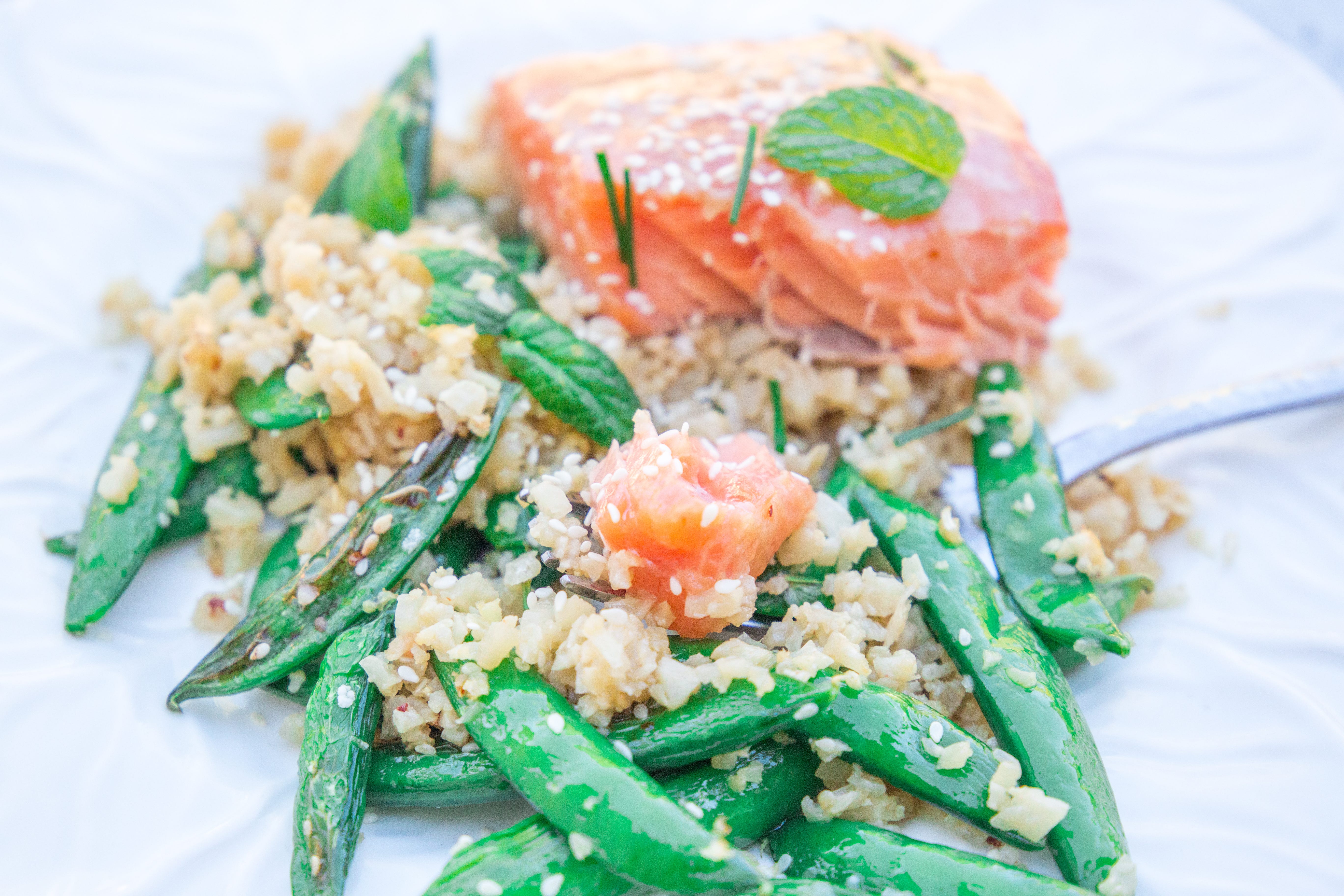
sheet-pan miso-ginger salmon with cauliflower rice and charred snap peas
Serves 2 to 4
Time: 20 minutes active, 1 hour total
Tools:
Small spoon
Microplane (optional)
Rimmed half sheet pan (FYI, that is the size of sheet pan I use when developing sheet-pan meals — I highly recommend them!)
Meat thermometer (if you do not own one, please, for the love, buy this now. It’s on sale for $8! You do not have x-ray vision — you can’t cook perfect meat without one!)
Ingredients:
2 tablespoons white or yellow miso
2 tablespoons maple syrup
3 tablespoons olive oil, divided
1 lime, divided
1 tablespoon low-sodium soy sauce
1-inch piece fresh ginger root, skin removed (optional) and grated
2 to 4 (6- to 8-ounce) salmon filets, preferably skin-on (see the notes section for how much to buy)
16-ounce bag of cauliflower rice (preferably fresh, but frozen is OK — can’t find either? See notes)
Kosher salt
16 ounces snap peas (or whatever size your bag is)
1 teaspoon toasted sesame seeds, plus more for garnish
Freshly ground black pepper
Handful of finely chopped soft green herbs such as cilantro, mint, basil, scallions, or chives, for garnish
In a large bowl, stir together 2 tablespoons miso, 2 tablespoons maple syrup, 2 tablespoons olive oil, the juice of 1/2 a lime, and 1 tablespoon low-sodium soy sauce.
Now, it’s ginger time. Grab a hold of it and use a small spoon to scrape the skin off of about 1 inch of ginger. Use a microplane or the smallest hole on a box grater to grate the peeled ginger straight into the bowl with the marinade. No grater? Just mince it as finely as you can with a chef’s knife. If your ginger is really fresh and has thin skin, you can skip scraping the skin off!
Run your fingers along the flesh of 2 to 4 (6- to 8-ounce) salmon filets to feel for any tiny bones that the fishmonger (yep, that’s the word for a fish butcher) may have accidentally left behind. Pull those suckers out, if you find some!
Add the salmon filets to the bowl and turn to coat them in marinade. Allow the salmon to marinate for at least 15 minutes at room temperature or up to 24 hours covered in the refrigerator.
When you’re about 1 hour from when you want to eat, place one oven rack in the center of the oven, and one on the top rung.
Preheat oven to 275°F.
Transfer the salmon filets from the marinade bowl to a rimmed sheet pan. Place them skin-side down and grouped tightly together — touching, so that it looks like one big piece of salmon — in one corner. Spread a thin layer of the miso-maple marinade over top of the salmon.
Keep the remaining marinade in the bowl and add to it 16 ounces of cauliflower rice and a big pinch of kosher salt. Stir until the cauliflower rice is evenly coated.
Yes, this is completely food safe, and no, it will not make the cauliflower rice taste fishy. Trust!
Transfer the cauliflower rice to the baking sheet and spread it into as even a layer as possible around the salmon. Don’t wash the bowl yet, you’re going to use it again!
Cook for 20 to 30 minutes, or until an internal thermometer inserted into the thickest part of the salmon registers 125°F for medium-rare, 135°F for medium, or 145°F for well done.
If you love sashimi, go for 125°F! If raw fish freaks you out, go for 145°F.
Meanwhile, toss 16 ounces of snap peas in the marinade bowl with the remaining 1 tablespoon olive oil, 1 teaspoon toasted sesame seeds, 1/2 teaspoon kosher salt, and several grinds of black pepper until coated.
Transfer the salmon to serving plates.
Turn the oven to broil on high.
Stir the cauliflower rice and spread it out across the entire baking sheet, taking up the empty space left by the salmon. Scatter the snap peas over the cauliflower rice in an even layer and return the baking sheet to the TOP rung of the oven.
Now it’s time to turn on the oven light, sit on your butt in front of the oven, and WATCH! Depending on how hot your broiler runs, it’s going to take between 3 and 5 minutes to quickly char those snap peas. When the snap peas are a bright, vibrant green and are just starting to char/blister in small spots, they’re ready. It’s OK if yours have more char (aka black spots) on them than the pic — just don’t let them burn to a crisp!
Divide the cauliflower rice and snap peas between the plates. Garnish with soft green herbs and a sprinkle of sesame seeds. Cut the remaining lime half into wedges and use those for a garnish, too!

link to printer version
Notes:
I hate salmon: First up, yes, you can sub a different fish for salmon (find the subs below!), but I beg of you, even if you “hate salmon,” give this a shot?! It is a completely different way of cooking salmon. I used to hate it, too, now I love it!
What kind of salmon should I buy? Any salmon will do, but personally I love Atlantic farmed salmon even though it is less nutritious and environmentally friendly. It tastes a lot better IMO.
How many salmon filets should I buy?/love your leftovers: Overall I’d recommend one filet per adult (and half a filet per kid). You could throw an extra one on there, if you want — I typically don’t recommend purposefully having fish leftovers, but because of the slow roast here, this salmon actually reheats beautifully in the microwave. Leftovers will keep for up to 3 days stored in an airtight container in the fridge.
Prep ahead: The fish can marinate for up to 24 hours covered in the fridge.
Feeding kids: Lots of kids love this recipe! For what it’s worth, for a few years I called salmon “pink chicken” so Mattis would eat it.
Make cauliflower rice at home: Throw half a head of chopped-up cauliflower into the food processor, and pulse until it’s the size of rice grains. Repeat with the other half. No food processor? Grate the head of cauliflower on a box grater.
Another cauliflower side idea: If you’re in the mood for a cozy side dish, after roasting your cauliflower rice, try blending it up with 1/4 cup heavy cream to make an unbelievable cauliflower purée.
Vegetarian: Slice 1 block of firm tofu into 1/2-inch-thick slices. Cook the exact same way. When it comes time to add the snap peas, don’t remove the tofu — broil it as well. Keep an eye on it!
Dairy-free: Already is.
Gluten-free: Some, but not all, miso contains gluten so read the ingredient list to make sure you’re buying a gluten/barley-free version! Also swap the soy sauce for coconut aminos or tamari, or use 1 teaspoon of kosher salt instead.
Soy-free: See the miso and soy sauce subs below!
Substitutions:
White or yellow miso: If you can’t find miso, or if you have a soy aversion, use Dijon or whole-grain mustard instead. You’ll end up with a maple-mustard salmon sitch and it will be fab.
Maple syrup: Brown sugar or honey
Olive oil: Avocado oil, EVOO, grapeseed oil, or another neutral cooking oil
Lime juice: Rice wine vinegar is best, but ANY clear vinegar works.
Low-sodium soy sauce: Coconut aminos, tamari, or shoyu, or just use 1 teaspoon of kosher salt instead. If you only have regular soy sauce, use 3/4 tablespoon of it + 1/4 tablespoon water.
Ginger: To make this a complete “dump” recipe, aka no chopping/grating of any kind, use 1/2 teaspoon ginger powder instead of fresh ginger. Or, omit the ginger altogether.
Salmon: Halibut, bass, arctic char, or grouper would all be great here. If you don’t want fish, chicken would be great: Use boneless, skinless chicken breasts or thighs. Marinate them the same way, but roast at 425°F for about 20 minutes, or until 160°F internally (the temp will continue to rise to get to 165°F). When it comes time to add the snap peas, don’t remove the chicken, broil it as well. Keep an eye on it as miso can burn quickly!
Cauliflower rice: If using frozen, you don’t have to thaw it. There isn’t really another great veggie that you can slow roast alongside the salmon. But, you can make a pot of normal rice while the salmon roasts, and serve the salmon and snap peas over rice. Brown butter scallion rice would be excellent here.
Snap peas: Green beans, asparagus (cut into 2-inch pieces), snow peas, frozen edamame. Watch closely while broiling so that you don’t overcook it. Green beans will need more time, edamame will need less.
Toasted sesame seeds: The sesame seeds are pretty much only for looks (I love garnishing meals with them!) — just omit if you have none.
Soft green herbs: Omit if needed.
A question you may have answered before: What do you recommend for mixed-protein houses? As in, I want to make this with salmon, husband wants it with chicken? Just basically do both versions of the recipe on one baking sheet? Husband eats no seafood and it is a major bummer.
I cooked this tonight- with chicken. I don’t like fish with a silent L. 😀 it was delicious! And running everything under the broiler gave the chicken a nice color. Yum! I will definitely make this again. Thanks!